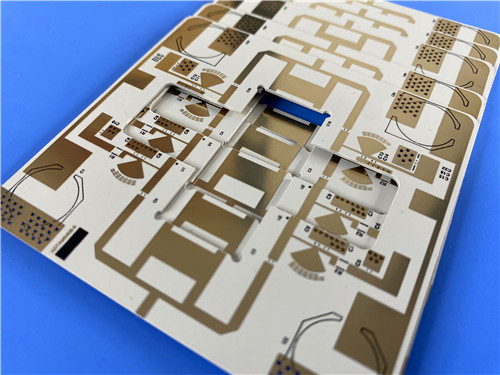
Heute präsentiere ich eine wirklich einzigartige benutzerdefinierte Leiterplatte, die aufWangling TP440- ein glasfaserfreies, keramisch gefülltes Thermoplast, das speziell für anspruchsvolle Anwendungen in der Luft- und Raumfahrt und im Verteidigungsbereich entwickelt wurde.
Diese benutzerdefinierte Leiterplatte wurde mit Wangling TP440 gebaut, einem Hochfrequenz-Thermoplast mit einer Dielektrikkonstante von 4.4Seine glasfaserfreie Konstruktion, Strahlungsbeständigkeit und geringe Abgasemissionen machen ihn ideal für GPS-Antennen, Raketensysteme und Sicherungen.Der gesamte Stromkreis wurde mit nur einem Netzwerk konzipiert, was auf eine hochspezialisierte HF-Komponente hinweist.
Wichtige Erkenntnisse
- Material: Wangling TP440, keramisch gefülltes PPO-Thermoplastik (Dk 4.4)
- Hauptvorteil: Keine Glasfaserverstärkung, präzise Dk, Strahlungsbeständigkeit, geringe Abgasemissionen
- Die Tafelgröße: 45,63 mm x 97,01 mm.
- Konstruktion: Doppelseitig, keine Lötmaske auf beiden Seiten aufgetragen, nur auf der oberen Schicht schwarze Seidenmaske verwendet
- Konstruktion: 24 Komponenten, 28 Durchgänge, nur ein Netz
- Qualität: IPC-Klasse 2 wurde erfüllt und 100% elektrische Prüfung durchgeführt
Die Herausforderung: Zuverlässigkeit in der Luft- und Raumfahrt und HF-Leistung
Unser Kunde benötigte ein Hochfrequenz-PCB für eine Einsatzkritik in der Luft- und Raumfahrt - wahrscheinlich eine GPS-Antenne, eine Zündschutzversorgung oder ein Raketensystem. Die Anforderungen waren nicht verhandelbar:Strahlungsbeständigkeit, geringe Ausgasung, stabile elektrische Leistung von -100°C bis +150°C und kompakter Formfaktor.
Traditionelle PTFE-Materialien mit Glasfaserverstärkung waren nicht in der Lage, die erforderliche Dimensionsstabilität oder Strahlungsbeständigkeit zu gewährleisten.Keramische Substrate boten die Leistung, waren aber schwer zu bearbeiten und zu verarbeiten.
Unsere Lösung: Wangling TP440
Es wurde TP440 ausgewählt, ein einzigartiges Material aus der Wangling TP-Serie.Das ist der Grund, warum es gewählt wurde:
Glasfaserfreies Bauen
Die dielektrische Schicht bestand ausschließlich aus Keramik und PPO-Harz, kein Glasfasergewebe wurde verwendet.Sicherstellung einer außergewöhnlichen Signalkonsistenz.
Genau gesteuerte Dk (4.4)
Die Dk-Werte von 3 bis 25 können in der TP-Serie durch Anpassung des Keramik-harz-Verhältnisses eingestellt werden.
Strahlungsbeständig und mit geringer Ausgasung
Diese Eigenschaften waren für Raumfahrt- und Luftfahrtanwendungen von entscheidender Bedeutung.Verhinderung der Kontamination empfindlicher Optik oder Elektronik.
Breiter Betriebstemperaturbereich
Zuverlässige Leistung von -100°C bis +150°C wurde erreicht, was dieses Material für die extremsten Luft- und Raumfahrtumgebungen geeignet macht.
Überlegene Bearbeitungsfähigkeit
Im Gegensatz zu keramischen Substraten (die eine spezielle Verarbeitung erfordern), kann TP440 mit Standard-PCB-Techniken bearbeitet werden, wobei Bohrungen, Fräsen, Scheren und Ätzen angewendet wurden.Die Kupferhaftung erwies sich auch als zuverlässiger als die von vakuumbeschichteten keramischen Substrate.
Spezifikationen für das Board
| Merkmal |
Spezifikation |
| Abmessungen |
450,63 mm x 97,01 mm (±0,15 mm) |
| Stack-up |
35 μm Cu / 1,5 mm TP440 / 35 μm Cu |
| Enddicke |
1.6 mm |
| Spuren/Raum |
5/8 ml |
| Min-Lochgröße |
0.3 mm |
| Oberflächenbearbeitung |
Immersionsgold |
| Lötmaske |
Keine (beide Seiten) |
| Seidenfilter |
Schwarz (nur oben) |
| Prüfungen |
100% elektrisch |
| Standards |
IPC-Klasse 2 |
Konstruktionsstatistiken
| Metrische |
Wert |
| Komponenten |
24 |
| Gesamtsumme der Pads |
19 (11 Durchlöcher, 8 SMT) |
| Durchgängen |
28 |
| Netze |
1 |
Das Single-Net-Design ist die aufschlussreichste Statistik. Es wurde ein einziger leitfähiger Pfad erstellt, z. B. eine Übertragungsleitung, eine Antennenzufuhr oder ein einfaches passives Netzwerk.Dies bestätigt, dass die Anwendung eine hochspezialisierte HF-Komponente ist., wahrscheinlich eine Antenne oder ein Netzwerk.
Keine Lötmaske (beide Seiten)
Die Lötmaske wurde beseitigt, um mögliche dielektrische Verluste oder Abgasbeiträge zu vermeiden, die für Luft- und Raumfahrtanwendungen von entscheidender Bedeutung sind, wo jede Variable gesteuert werden muss.
Schwarze Seidenwand (nur oben)
Es wurde schwarzer Seidenschirm aufgetragen, um einen hervorragenden Kontrast für die Identifizierung der Bauteile zu schaffen und gleichzeitig ein professionelles Erscheinungsbild zu erhalten.
Immersion Gold Finish
Das Immersionsgold wurde ausgewählt, um eine flache, geschweißbare Oberfläche mit ausgezeichneter Korrosionsbeständigkeit und Drahtbindungsfähigkeit zu liefern.
1.6 mm Enddicke
Die dickere Platte wurde spezifiziert, um eine mechanische Robustheit für Luft- und Raumfahrtanwendungen zu gewährleisten, bei denen Vibrations- und Stoßbeständigkeit unerlässlich sind.
Vergleich: Wie sich TP440 stapelt
| Eigentum |
TP440 |
Standard-PTFE |
Keramisches Substrat |
| Glasfaser |
- Nein. |
Normalerweise. |
- Nein. |
| Dk-Bereich |
3 ¢ 25 (ausgerichtet) |
2.2·10 |
Unterschiede |
| Strahlungsbeständigkeit |
Ausgezeichnet. |
Moderate |
Ausgezeichnet. |
| Ausgasung |
Niedrig |
Niedrig |
Sehr niedrig |
| Verarbeitbarkeit |
Ausgezeichnet. |
Das ist gut. |
Arme |
| Maximale Betriebstemperatur |
150°C |
150°C bis 260°C |
> 300°C |
Warum das wichtig ist: TP440 bietet die Strahlungsbeständigkeit und geringe Ausgasung von Keramiksubstraten mit der ausgezeichneten Bearbeitbarkeit von PTFE, einer seltenen Kombination.Die Glasfaserfreie Konstruktion gewährleistet eine überlegene Dk-Einheitlichkeit.
Ideale Anwendungsmöglichkeiten
- GPS-Antennen, die eine stabile Leistung in Raumbedingungen erfordern
- Raketengetriebene Systeme, die Stoß- und Strahlungsbeständigkeit erfordern
- Sicherungen, für die eine kompakte und sehr zuverlässige HF-Schaltung erforderlich ist
- Miniaturisierte Antennen für Luft- und Raumfahrt- und Verteidigungsanwendungen
- Beidou-Satellitennavigationssysteme
F: Was unterscheidet TP440 von PTFE-Materialien?
A: Bei TP440 wird keine Glasfaserverstärkung verwendet, denn der Dielektrikum besteht ausschließlich aus Keramik und PPO-Harz.mit einer höheren Dimensionsstabilität und Strahlungsbeständigkeit.
F: Warum hat dieses Design nur ein Netz?
A: Ein einziger leitfähiger Pfad wurde entwickelt, wie z. B. eine Antennenzuführungsleitung oder ein passives HF-Netzwerk.
F: Was bedeutet "strahlungsbeständig" in der Praxis?
A: Das Material behält seine elektrischen und mechanischen Eigenschaften bei, wenn es Strahlung ausgesetzt ist (z. B. im Weltraum oder in nuklearen Umgebungen).
F: Warum wurde TP440 anstelle eines keramischen Substrats gewählt?
A: TP440 bietet ähnliche elektrische und strahlungsbeständige Eigenschaften, ist aber viel einfacher zu bearbeiten, wenn Standard-PCB-Fertigungsmethoden verwendet werden.Keramische Substrate erfordern eine spezielle Verarbeitung wie Laserbohrung und Vakuumbeschichtung.
F: Was ist die Bedeutung von 28 Durchgängen mit einem 1-Netz-Design?
A: Durch die hohe Via-Zählung entstanden wahrscheinlich ausgedehnte Erdungsstrukturen, die eine gut definierte Bodenebene oder Abschirmung für den einzelnen Signalpfad bildeten.
F: Ist dieses Material für Raumfahrtanwendungen geeignet?
A: Ja. Die geringe Abgas- und Strahlungsbeständigkeit macht den TP440 zu einer ausgezeichneten Wahl für Raumfahrt und Luftfahrt.
Schließende Gedanken
Die einzigartige Kombination von Eigenschaften des Wangling TP440, Glasfaserfrei, präzise Dk-Steuerung, Strahlungsbeständigkeit,und eine hervorragende Bearbeitbarkeit machen sie zu einer hervorragenden Wahl für anspruchsvolle Anwendungen in der Luft- und Raumfahrt und im Verteidigungsbereich.Wenn Ihre Mission in den härtesten Umgebungen Zuverlässigkeit erfordert, liefert dieses Material.
Haben Sie ein Luft- und Raumfahrt- oder Antennenprojekt im Sinn?


 Ihre Nachricht muss zwischen 20 und 3.000 Zeichen enthalten!